We may earn an affiliate commission when you purchase through links on our site. This keeps it 100% reader-supported and free of ads or sponsorships. Thanks for your support!
A bakery mixer has a harder job than a pizzeria mixer, not because the dough is tougher but because there is more variety. Bread one hour, cake batter the next, buttercream after that. The machine that handles all three is a planetary, and the question is really what size and what build quality.
Bread dough is also easier on a machine than pizza dough. At 60% absorption, Hobart rates a 20-quart planetary for 25 lb of bread dough against just 9 lb of thin pizza dough. That means a bakery gets more usable capacity out of the same bowl than a pizza shop does.
Start With Loaves Per Day
Bakeries size on daily output, and the cleanest unit is loaves. A standard sandwich loaf takes roughly 1.5 lb of dough, so the arithmetic is straightforward once you know your daily count.
| Mixer size | Bread dough per batch | Loaves per batch | Batches for 100 loaves |
|---|---|---|---|
| 12 quart | 13 lb | about 9 | 12 |
| 20 quart | 25 lb | about 17 | 6 |
| 30 quart | 45 lb | about 30 | 4 |
| 60 quart | 80 lb | about 53 | 2 |
Read that last column carefully, because it is where bakeries get caught. Twelve batches on a 12-quart machine is not a capacity problem, it is a staffing problem. Each batch costs scaling, mixing, resting, and cleanup, and it heats a motor that never fully cools.
Worked Example: A 50-Loaf Morning
Take a bakery selling 50 loaves on a good Saturday, mostly 1.5 lb sandwich and country loaves. That is 75 lb of dough before you account for pastry, which most bakeries mix separately anyway.
- On a 12-quart machine at 13 lb per batch, that is six batches.
- On a 20-quart at 25 lb, three batches.
- On a 30-quart at 45 lb, two batches.
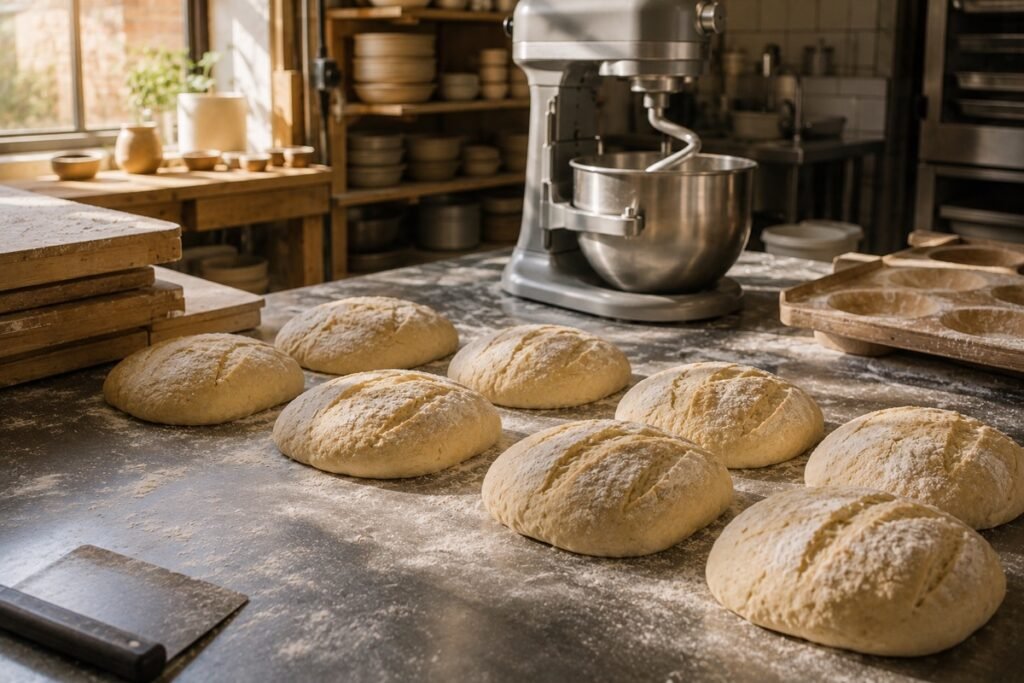
Six batches before the doors open is the difference between one baker and two, or between a 4am start and a 2am one. The 20-quart is the practical floor here and the 30-quart is the comfortable answer, which is why so many small bakeries land on a 30 even when the arithmetic says they could scrape by smaller.
Picks by Bakery Size
| Operation | Start with |
|---|---|
| Home bakery or farmers market | Ankarsrum 6230 or Bosch Universal Plus |
| Cottage bakery going licensed | KitchenAid KSM8990 (NSF certified) |
| Cafe with a bake program | Hobart N50 or Vollrath 10-Quart |
| Small bakery, up to 100 loaves | VEVOR 20Qt or a 20 to 30 qt commercial planetary |
| Established bakery, 100+ loaves | Eurodib M30AETL 30-Quart or Globe SP30 |
Sourdough and Artisan Loaves Change the Numbers
The figures above assume standard bread dough at 60% hydration. Artisan and sourdough bakeries usually run wetter, with hearth loaves typically 65 to 75% and open-crumb sourdough often 75 to 80%.
It would be convenient if wetter simply meant more capacity, and plenty of advice says so. Hobart’s own chart says otherwise. Whole wheat dough at 70% absorption is rated lower than light bread dough at 60%, at 20 lb against 25 lb on a 20-quart machine. Flour composition matters as much as water content, because bran and whole grain change how the dough behaves under the hook.
The practical takeaway for an artisan bakery: size from the closest published dough type rather than interpolating from your hydration number, and if you mix a lot of whole grain, use the whole wheat rating rather than the white bread one. A 20-quart handling 25 lb of white sandwich dough is a 20 lb machine once you switch to a whole wheat country loaf, which is roughly 13 loaves per batch instead of 17.
Why Bakeries Should Buy Planetary
Pizzerias can justify a spiral mixer because dough is nearly all they make. A bakery cannot. A spiral does one job beautifully and cannot whip cream, cream butter and sugar, or make a meringue, and those are daily tasks in most bakeries.
A planetary with three agitators covers the whole menu: dough hook for bread, flat beater for batters and creaming, wire whip for eggs and cream. If bread volume eventually outgrows the planetary, the usual answer is to add a spiral for dough rather than replace the planetary, since you still need it for everything else. Our planetary vs. spiral comparison covers where that line falls.
The Attachment Hub Matters More Here
In a small bakery with limited counter space, the hub is what turns one machine into several. Through a single geared port a planetary can drive graters, slicers, and grinders, which matters if you shred cheese for savouries or grind nuts for fillings.
Hub sizes are standardised by machine class. The #10 hub appears on 5-quart countertop machines like the Hobart N50, the #12 hub is standard on 20, 30, and 40-quart mixers, and the #22 hub on 60-quart and larger. Attachments are sold by hub number and are not interchangeable, so confirm yours before buying accessories. Our sizing guide has the full breakdown.
Certification and the Licensed Kitchen
This is the step that catches cottage bakers going commercial. Many health departments require NSF certification for equipment in a licensed kitchen, and a machine that has served you faithfully at home may not pass inspection.
The Ankarsrum and Bosch Universal Plus both handle bread dough well above their size class, but neither is NSF certified. The KitchenAid KSM8990 is, which is why it is the common first commercial purchase for a bakery going licensed. Requirements vary by jurisdiction and inspectors differ on what they will accept, so ask yours what they want to see before you spend anything.
At 20 quarts and up, confirm the machine has a bowl guard and a bowl lift rather than a tilting head. A 30-quart bowl holding 45 lb of dough plus the bowl itself is a two-person lift, and bakeries run early shifts with thin staffing, which is exactly when that becomes a problem.
Buy One Class Above Today
Bakeries grow in steps rather than smoothly. A wholesale account, a farmers market stall, or one good write-up can double output in a month, and a mixer is a 15 to 20 year asset that should absorb that.
The practical rule: pick the machine that covers your busiest morning in two or three batches, not the one that just barely covers your average day. Do not overshoot by two classes though. A 60-quart bowl handling a 6 lb test batch of brioche will smear it around the sides rather than mix it, so an oversized machine costs you on small runs as well as on floor space.
Frequently Asked Questions
What size mixer do I need for a small bakery?
For up to about 100 loaves a day, a 20 to 30-quart planetary is the practical range. A 20-quart handles roughly 17 loaves per batch and a 30-quart about 30, using Hobart’s rated bread-dough capacity at 60% absorption. Below 50 loaves a day, a 10 or 12-quart bench machine can work.
Can I start a bakery with a KitchenAid?
You can start a licensed bakery with the NSF-certified commercial KitchenAid models, and many people do. What you cannot do is run high volume through one. KitchenAid rates the KSM8990 at 8 and 1/4 loaves per bowl, but that figure assumes roughly 1 lb loaves. At the 1.5 lb sandwich loaf most bakeries sell, you are closer to five or six per batch. Treat it as a starting machine, or a second machine for pastry work, rather than a long-term production mixer.
Do I need a spiral mixer for a bakery?
Not as your first machine. A spiral handles bread dough better but cannot whip, cream, or beat, which rules out most pastry work. Bakeries that reach high bread volume usually add a spiral alongside the planetary rather than replacing it.
How many loaves can a 20-quart mixer make?
About 17 standard loaves per batch, based on Hobart’s 25 lb rating for bread dough at 60% absorption and roughly 1.5 lb of dough per loaf. Higher-hydration doughs get closer to that figure, while stiffer doughs such as bagel or pretzel reduce it substantially.
Bottom Line
Count your loaves, multiply by 1.5 lb, then pick the smallest machine that does your daily volume in two or three batches rather than a dozen. Buy planetary for the versatility a bakery needs, confirm NSF if you are licensed, and round up rather than down.
If your bread volume climbs past what a planetary comfortably handles, our planetary vs. spiral comparison covers when to add a dedicated dough machine. For the underlying capacity method, see the sizing guide, and our reviews cover individual models.
Capacity figures cited from the Hobart Mixer Capacity Chart (F-7701), based on 12% flour moisture at 70°F water temperature. Product specifications verified against current Amazon listings in July 2026.
We may earn an affiliate commission when you purchase through links on our site. This keeps it 100% reader-supported and free of ads or sponsorships. Thanks for your support!