
These two machines get cross-shopped constantly, and the spec sheets make the comparison look lopsided in a way it is not. The KitchenAid lists a 1.3 HP motor against the Hobart’s 1/6 HP, holds 8 quarts against the Hobart’s 5, and offers 10 speeds against 3. On paper it wins every line.
Then you pick them up. That 5-quart Hobart weighs 50 lb against 30 for the 8-quart KitchenAid. That gap is the actual story, and it explains why kitchens still buy the smaller, pricier machine.
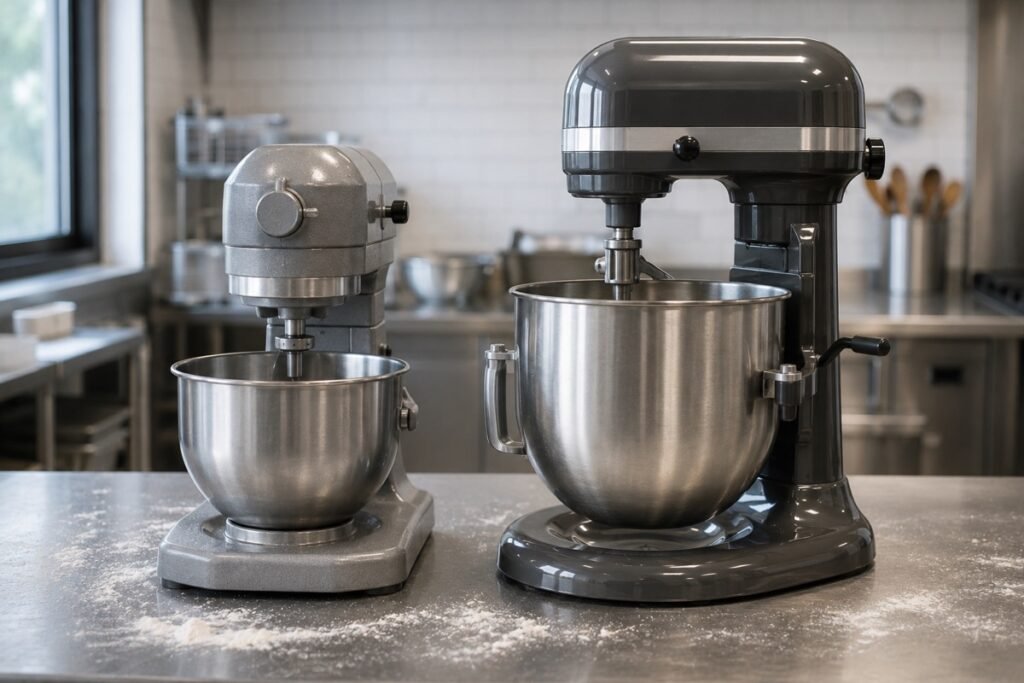
There is history here too. Hobart originally manufactured KitchenAid stand mixers, and the two brands separated in the 1980s. That shared lineage is why a Hobart N50 still accepts standard #10 attachments, including KitchenAid’s.
Specifications Side by Side
| Specification | Hobart N50 | KitchenAid KSM8990 |
|---|---|---|
| Bowl capacity | 5 quarts | 8 quarts |
| Bowl mechanism | Manual bowl lift | Bowl lift |
| Planetary action | Yes | Yes |
| Motor | 1/6 HP output at the planetary shaft (348 W), full power at every speed | 1.3 HP DC (500 W), peak at top speed |
| Speeds | 3 | 10 |
| Transmission | All-gear, all-metal | Gear driven |
| Weight | 50 lb | 30 lb |
| Attachment hub | #10 | Standard KitchenAid |
| Certification | UL listed, NSF approved | NSF certified commercial |
| Warranty | 1 year, parts, labor, and travel | 2 year commercial replacement |
| Built in | United States | Varies |
Specifications drawn from the Hobart N50 spec sheet (F7533) and KitchenAid’s KSM8990 product documentation. Figures were checked against those documents and against current retail listings in July 2026. Confirm against the sheet for the exact configuration you are buying, since voltage and colour variants differ.
One point of confusion worth clearing up: neither of these is a tilt-head mixer. Both raise the bowl to the agitator rather than tipping the head back, which is standard on commercial machines at this size and is why both feel less convenient than a domestic tilt-head for quick scraping.
The Horsepower Number Is Misleading
Put 1.3 HP next to 1/6 HP and the KitchenAid looks roughly eight times stronger. It is not. Those two figures measure different things.
The two brands are not even measuring the same place in the machine. Hobart’s spec sheet rates the N50 at “1/6 HP output at the planetary shaft”, meaning work actually delivered to the agitator after the gear reduction. KitchenAid’s 1.3 HP describes the motor. Comparing them is comparing an output figure to an input figure. That is a design choice about duty cycle rather than a marketing number, and it is why a smaller Hobart can work dough that bogs down a nominally stronger machine.
There is a second difference underneath that one. KitchenAid’s DC motor reaches its rated output only at top speed, while Hobart’s fixed-speed motor delivers full power at all three, so torque at low speed, which is exactly where dough gets kneaded, never falls away. Treat published horsepower as close to meaningless when comparing across brands. Rated dough capacity at a stated absorption ratio is the number that actually predicts performance, which is the approach our sizing guide uses.
Where the KitchenAid Wins
Capacity. Eight quarts against five is a meaningful difference, and it is the single best reason to choose the KitchenAid. KitchenAid rates the KSM8990 for 16 cups of flour, 13 dozen cookies, or dough for 8 and 1/4 loaves of bread in one bowl. Hobart’s own capacity chart rates the N50 at 4 lb of bread dough at 60% absorption. If your batches do not fit in 5 quarts, build quality is irrelevant.
Speed range. Ten speeds against three matters for delicate work. Whipping small quantities of cream or egg whites benefits from fine control that a three-speed gearbox cannot offer.
Price. A new Hobart costs several times what the KitchenAid does. For a kitchen that mixes a few batches a day, that difference buys a lot of other equipment.
Weight, if you need to move it. Thirty pounds can be shifted by one person. Fifty is a two-person job or a permanent installation.
Where the Hobart Wins
Service life. This is the whole argument. The N50 uses an all-gear, all-metal transmission built to be opened and rebuilt, which is why working N50s from decades ago are still in commercial kitchens and still have parts available. It is a machine you maintain rather than replace.
Continuous duty. Full power at every speed means the motor is not straining to knead at low speed. A machine that runs most of the service day is a different engineering problem than one that runs six times a day, and the N50 is built for the former.
Warranty type, not length. Two years beats one on paper. Look at what each actually covers. Hobart’s includes parts, labor, and travel time, which means a technician comes to the machine. KitchenAid’s is a replacement warranty. Longer coverage and better coverage are not the same thing, and for equipment that is awkward to ship, on-site service is worth more per year.
Resale and the used market. Hobart mixers hold value in a way domestic-lineage machines do not, because the used commercial market knows the transmission can be rebuilt. That cuts both ways when buying. A refurbished N50 from a dealer who has opened and serviced the transmission is often the sensible way into this machine, and it narrows the price gap considerably. Ask what was replaced, and confirm the bowl, beater, whip, and dough hook are all present, since Hobart ships all four and replacements are expensive.
Which Should You Buy
Buy the KitchenAid KSM8990 if you need 8 quarts, you mix several batches a day rather than continuously, you want fine speed control for whipping and creaming, or the budget difference matters. It is NSF certified, so it passes inspection in a licensed kitchen. For most cafes, caterers, and dedicated prep stations, this is the correct answer.
Buy the Hobart N50 if the machine will run most of the day, every day, and 5 quarts is genuinely enough. You are buying a twenty-year asset with a rebuildable transmission and on-site warranty service. If you mix continuously in small batches, this is cheaper over a decade despite costing more today.
Buy neither if your real problem is capacity. Both are countertop machines. If you are regularly mixing more than 8 quarts, the answer is a bench or floor machine, and our buying guide covers how to work out which class you belong in.
Frequently Asked Questions
Is the Hobart N50 worth the extra money over a KitchenAid?
It depends entirely on duty cycle. If the mixer runs most of the service day, the N50’s rebuildable gear transmission and on-site warranty service make it cheaper over ten years. If you mix a few batches a day, the KitchenAid does the same work for far less money and gives you three more quarts of capacity.
Do KitchenAid attachments fit the Hobart N50?
Yes, for hub attachments. The N50 uses a standard #10 taper hub and accepts any #10 attachment, including KitchenAid’s. Bowl and beater attachments are a different matter, since parts sized for KitchenAid 6 or 7-quart machines are too wide for the N50’s 5-quart bowl.
Why does the KitchenAid list more horsepower than the Hobart?
Because manufacturers measure it under different conditions, and neither is obliged to say which. A peak figure taken at top speed will always dwarf a continuous-duty rating, even when the continuous-duty machine handles dough better. Ignore the headline number and compare rated dough capacity at a stated absorption ratio, which is the one specification both brands publish on comparable terms.
Is the Hobart N50 NSF certified?
Yes. The N50 is NSF approved and UL listed, so it meets the sanitation and electrical requirements most health departments apply to equipment in a licensed commercial kitchen. The KitchenAid KSM8990 is also NSF certified, so certification does not separate these two machines.
Bottom Line
The KitchenAid KSM8990 is the better buy for most kitchens, because more capacity for less money solves the problem most buyers actually have. The Hobart N50 is the better machine, and the right one when a mixer runs continuously and you intend to keep it for decades.
Decide on duty cycle first, then capacity. If you are still unsure which size class you need, start with the sizing guide, and see our full mixer reviews for the alternatives in each class.
The service-life argument here is covered in full in our guide to how long a commercial mixer should last.