
We may earn an affiliate commission when you purchase through links on our site. This keeps it 100% reader-supported and free of ads or sponsorships. Thanks for your support!
Pizza dough is the hardest thing most commercial mixers are asked to do, and the reason is hydration. A stiff, low-hydration dough loads a motor and transmission far harder than bread or batter, which is why a mixer that looks adequate on the box burns out in a pizzeria.
The number that decides everything here is absorption ratio, water weight divided by flour weight. Hobart’s published capacity chart puts thin pizza dough at 40% and rates a 20-quart planetary for just 9 lb of it, against 25 lb of standard bread dough in the same bowl. Same machine, same quarts, less than half the capacity.
So the honest answer to “what is the best mixer for pizza dough” depends on two things: how much you make per day, and how wet your dough is. Below are the picks by volume, then the reasoning.
Quick Picks by Volume
| Daily volume | Best choice | Why |
|---|---|---|
| Home or up to about 20 pizzas | Ooni Halo Pro Spiral Mixer | True spiral action at 110V, 7.3 qt |
| Small shop, 20 to 60 pizzas | VEVOR 8.5Qt dual rotating | Spiral-style bowl rotation, timer, bowl guard |
| Busy shop, 60 to 150 pizzas | Vollrath 10-Quart or a 20 to 30 qt planetary | Bench capacity with commercial build |
| High volume, 150+ pizzas | Globe SP30 or a dedicated spiral | Floor-class capacity and duty cycle |
Why Spiral Beats Planetary for Dough
A planetary mixer holds the bowl still and orbits an agitator through the dough. A spiral mixer rotates the bowl while a fixed spiral hook works the dough as it passes. That difference matters more with stiff dough than with anything else you mix.
The rolling, folding action mimics hand kneading, developing gluten evenly without overworking the dough. It also puts far less strain on the drivetrain, because the bowl is doing part of the work instead of the motor fighting a static mass. That gentler handling is why spiral machines are the standard recommendation for Neapolitan dough, which runs 55 to 62% hydration and needs delicate gluten development. For a shop mixing dough and little else, a spiral is the correct machine, and our planetary vs. spiral comparison covers the tradeoffs in detail.
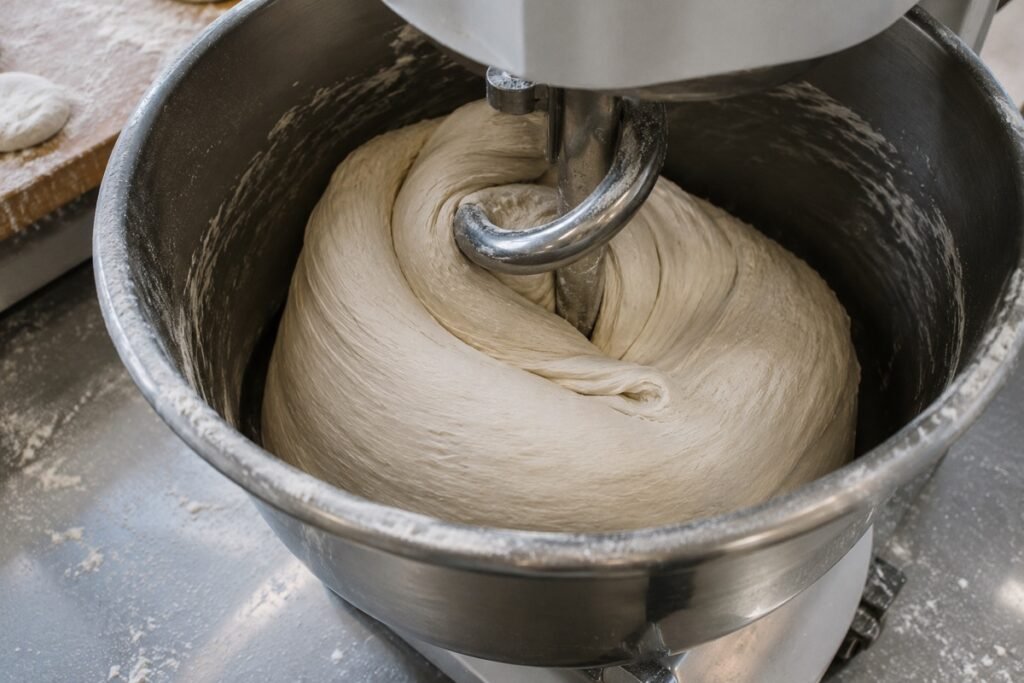
The catch has always been availability. Most true commercial spirals are 220V or three phase, which rules them out for kitchens on standard single-phase power. That has started to change at the small end.
The Picks in Detail
Ooni Halo Pro: spiral action on a normal outlet
The Ooni Halo Pro is the most interesting machine in this category right now, because it brings genuine spiral mixing (rotating bowl plus fixed spiral hook) into a 7.3-quart countertop unit that runs on 110V at 650W. It carries 58 speed settings from 60 RPM to over 1,000, which is far finer control than the three speeds on a traditional commercial planetary.
At roughly 32 lb it is a countertop machine, not a floor unit, and 7.3 quarts caps your batch size. For a serious home pizza maker, a supper club, or a small operation doing a couple of dozen pies, it delivers the mixing action that matters without a three-phase panel.
VEVOR 8.5Qt dual rotating: the budget step up
The VEVOR 8.5Qt uses dual rotation, meaning the bowl turns as the hook works, giving you spiral-style behaviour at a lower price. It runs 110V at 450W and includes a timer and a security shield. The telling number is the weight: 81.6 lb for an 8.5-quart machine means it is built more like commercial gear than the modest wattage suggests.
Treat it as a light-commercial machine. It suits a small pizzeria mixing a few batches a shift rather than one running continuously.
Bench and floor planetary: when capacity wins
Past roughly 60 pizzas a day, batch size beats mixing elegance. A 20 or 30-quart planetary will out-produce a small spiral simply because it moves more dough per cycle, even though each cycle is harder on the machine. The Vollrath 10-Quart is a reasonable entry, and stepping to 30 quarts gets you 20 lb of medium pizza dough per batch against 10 lb on a 20-quart.
Use the absorption-ratio arithmetic before committing. Our sizing guide works through a 200-pizza day and shows why the answer lands two size classes above where most owners guess.
Dough Temperature Is the Metric That Decides Quality
Capacity gets the attention, but the number experienced pizzaiolos actually track is finished dough temperature. Mix too warm and fermentation runs away from you before the dough reaches the cooler.
PMQ Pizza Magazine puts the target at 75 to 80°F if you have a walk-in cooler, or 70 to 75°F with a reach-in. Every minute under the hook adds heat, which is the friction factor, the temperature the dough gains during mixing.
You control it through water temperature. The working formula is to multiply your desired finished dough temperature by three, then subtract the sum of the flour temperature, the room temperature, and the friction factor.
Worth being precise here, because it is often oversimplified. Spiral mixers are widely recommended for their gentler action, but PMQ advises using a friction factor of 20 for either a planetary or a spiral as a starting point, and recalculating whenever you change absorption, mixing time, or batch size. In other words, do not assume a spiral solves dough temperature on its own. Measure your own friction factor with a probe thermometer and adjust water temperature from there, whichever machine you buy.
The practical mixer consequence: a machine that mixes a batch faster spends less time adding friction heat. Undersizing costs you twice, once in labour across extra batches and again in dough quality as each longer mix runs warmer.
Check the Voltage Before You Buy
This is where pizzeria owners buying online get caught. Plenty of capable spiral mixers listed on Amazon ship with electrical specs that will not work in a standard American kitchen. The Hakka 30 Qt spiral is a good machine, but its listing specifies 380V, 50Hz, three phase, which is a European standard. Dropping it into a typical US shop means a transformer and panel work that can cost more than the mixer.
Read the voltage and phase in the specification table rather than the marketing copy, on every machine at this size.
Frequently Asked Questions
What size mixer do I need for 100 pizzas a day?
At roughly 14 oz of dough per 14-inch pizza, 100 pizzas is about 88 lb of dough. On Hobart’s chart a 30-quart planetary handles 20 lb of medium pizza dough at 50% absorption, so that is around five batches a day. A 30-quart is workable, a 60-quart is comfortable, and a spiral sized for dough alone is better than either if pizza is all you make.
Can a KitchenAid handle pizza dough?
For home volumes, yes. For a commercial kitchen, only at small batch sizes. Pizza dough’s low hydration means an 8-quart commercial KitchenAid delivers well under its bread-dough rating, and running it at capacity every shift is how motors fail early. It is a prep-station machine in a pizzeria, not the main dough mixer.
Is a spiral mixer worth it for a small pizzeria?
If dough is the bulk of what you mix, yes. Spiral mixing keeps dough cooler through a long mix and puts less strain on the drivetrain, so the machine lasts longer doing the same work. If you also mix sauces, cheese, batters, and fillings, a planetary is more versatile and probably the better single purchase.
What hydration should pizza dough be?
It depends on style. Neapolitan runs 55 to 62%, New York style typically 60 to 65%, and thin or cracker-style crusts drop to 40 to 50%. Lower hydration makes stiffer dough that demands more mixer, so size the machine to the lowest hydration you regularly run, not your average.
Bottom Line
For pizza specifically, mixing action matters as much as capacity. A spiral handles stiff dough better than a planetary of the same size, and 110V spiral options now exist at the small end where they did not a few years ago.
Work out your daily dough weight, find your hydration, then size from the manufacturer’s rating at that hydration rather than the bowl number. The sizing guide has the arithmetic, the buying guide covers the wider decision, and our reviews cover the machines in each class.
Capacity figures cited from Hobart Mixer Capacity Chart F-7701. Product specifications verified against current Amazon listings in July 2026.
We may earn an affiliate commission when you purchase through links on our site. This keeps it 100% reader-supported and free of ads or sponsorships. Thanks for your support!