
We may earn an affiliate commission when you purchase through links on our site. This keeps it 100% reader-supported and free of ads or sponsorships. Thanks for your support!
If you have outgrown a standard tilt-head mixer and started shopping for something that can knead real bread dough without walking across the counter, you land on the same two machines almost immediately. The Bosch vs Ankarsrum decision is the one serious home bakers argue about most, and for good reason: both are built for high-volume dough, both cost far more than a consumer mixer, and both take a different approach to the same problem.
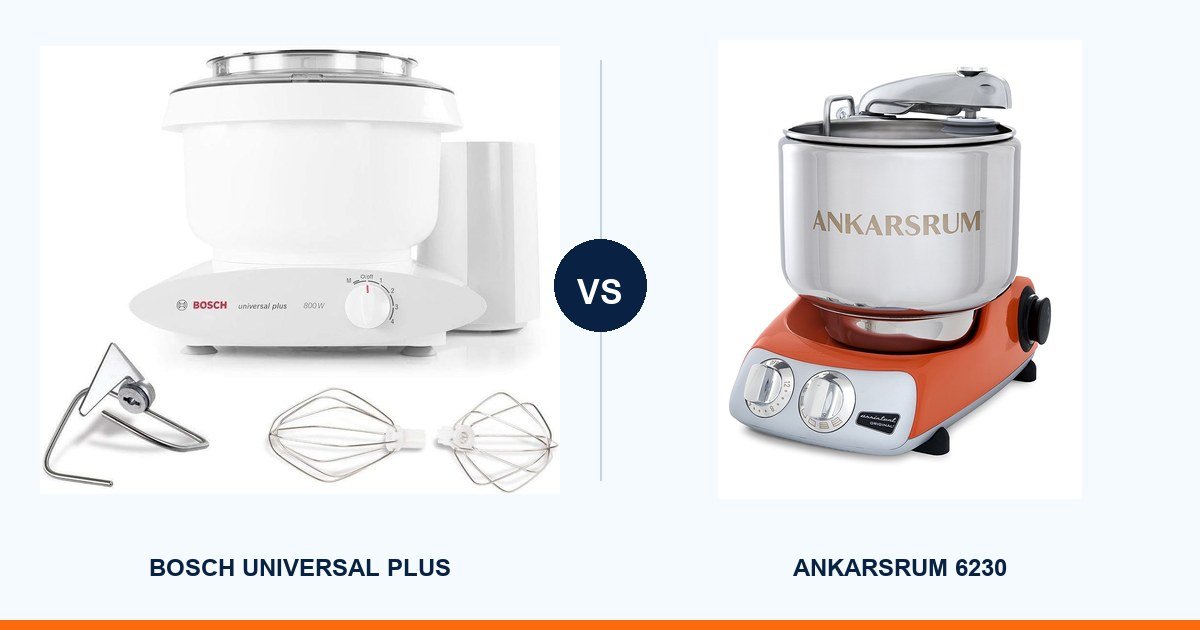
We have reviewed both machines in full. This comparison pulls the two side by side so you can see where each one actually wins, and which of them fits the way you bake.
Bosch vs Ankarsrum at a glance
| Bosch Universal Plus | Ankarsrum 6230 | |
|---|---|---|
| Motor | 800 watts, German engineered | 600 watts, bottom mounted |
| Dough capacity | 6.5-quart bowl | 7.4-quart (7 L) stainless bowl, up to about 11 lbs of dough |
| Speeds | 4 speeds plus pulse | Variable 45 to 130 RPM with electronic load sensor |
| Timer | None | 12-minute timer built into the on/off knob |
| Warranty | 3-year motor and transmission, 1-year attachments | 7-year motor, 1-year attachments |
| Price | Lower, typically a few hundred dollars less | Higher, the premium of the two |
| Weight | Lighter, easy to move | 19 lbs |
| Best for | Value, versatility, replacing several appliances | Bread baking, long-term durability |
Bosch Universal Plus: the value pick
The Bosch Universal Plus (model MUM6N10UG) is the more affordable of the two, and it earns its place on raw capability rather than price alone. Its 800-watt German-engineered motor is the stronger of the two on paper, and owners consistently report it handles heavy batter and dough without the overheating that stops lesser machines mid-batch.
What makes it stand out: the open bowl design. There is no mixer head to lift, so you can add flour or ingredients while it runs without stopping or making a mess, and you can watch the dough come together.
- Pros: the most powerful motor of the two, a 6.5-quart BPA-free bowl with a removable drive shaft for easy cleaning, four speeds plus pulse, and an attachment range (blender, food processor, meat grinder, pasta roller, citrus juicer) that genuinely replaces several countertop appliances.
- Cons: the bowl needs hand washing and care, dough hides in the small crevices if you do not clean it immediately, and first-time buyers often flinch at the price before they understand what they are getting.
Best for: the baker who wants maximum capability per dollar and likes the idea of one machine doing the job of three. Read our full Bosch Universal Plus review, or check the current price on Amazon.
Ankarsrum 6230: the bread specialist
The Ankarsrum 6230 is the more expensive machine, and it is widely considered the standard for bread baking. It works differently from almost everything else on the market: the motor sits in the base rather than the head, and the bowl itself rotates while a roller or hook works the dough against it.
What makes it stand out: the warranty and the dough handling. Seven years on the motor is nearly unheard of, and the electronic speed sensor adjusts torque to the load automatically, so the machine does not bog down as a stiff dough tightens.
- Pros: a 7.4-quart stainless bowl rated to about 11 pounds of dough, a 12-minute timer so you can walk away mid-knead, overload protection on the motor base, a separate 3.5-liter Tritan beater bowl that will not scorch with boiling sugar or hold a fatty film after whipping cream, and an attachment range covering grain mills, a meat grinder, slicers and pasta discs.
- Cons: it costs meaningfully more than the Bosch, at 19 pounds it is not a machine you move often, and the roller-and-bowl method has a genuine learning curve if you have only ever used a conventional mixer.
Best for: the baker whose main job is bread, especially in volume, and who wants a machine that will still be running in a decade. Read our full Ankarsrum 6230 review, or check the current price on Amazon.
Where the Bosch vs Ankarsrum decision actually gets decided
Dough capacity
The Ankarsrum takes this one. Its stainless bowl runs 7.4 quarts and is rated to about 11 pounds of dough, against 6.5 quarts on the Bosch. If you routinely bake four loaves at a time, that gap matters. If you bake two, both machines are more than enough.
Motor and control
This one splits. The Bosch has more raw power at 800 watts versus 600. The Ankarsrum has smarter power: an electronic sensor that reads the load and adjusts torque, plus a much wider usable speed range and a built-in timer. More watts is not automatically better if the machine cannot hold speed under a stiff dough.
Cleaning
Close, with a slight edge to the Bosch thanks to its removable drive shaft. Both punish you for letting dough dry. Clean either one right after use and neither is a chore.
Warranty and lifespan
The Ankarsrum wins clearly: 7 years on the motor against 3 years on the Bosch motor and transmission. Spread across the life of the machine, that warranty gap closes a real part of the price difference.
Versatility beyond dough
Both expand well. The Bosch leans toward replacing kitchen appliances outright with its blender and food processor attachments. The Ankarsrum leans toward the grain-to-loaf baker with flake and grain mills. Pick based on what you actually want the machine to absorb.
Which one should you buy?
- Buy the Bosch Universal Plus if you want the most capability for the money, you bake a range of things rather than mostly bread, or you want one machine to replace a blender and food processor too.
- Buy the Ankarsrum 6230 if bread is your main output, you mix large batches, or you are buying a machine you intend to keep for a decade and want the warranty to match.
Both are a substantial step up from a conventional tilt-head mixer, and both will outlast the machine you are replacing. The honest tiebreaker is budget. The Bosch typically lands a few hundred dollars below the Ankarsrum, which is a real gap at this end of the market. If the Ankarsrum price does not make you hesitate, its warranty and dough capacity make it the stronger long-term buy. If it does, the Bosch gives up very little and keeps real money in your pocket.
Frequently asked questions
Is the Ankarsrum better than the Bosch for bread?
For bread specifically, yes. The Ankarsrum has the larger bowl (7.4 quarts, rated to about 11 pounds of dough), a load-sensing motor that holds speed as dough stiffens, and a 12-minute timer for long kneads. The Bosch handles bread well, but the Ankarsrum is purpose-built for it.
The Bosch has 800 watts and the Ankarsrum only 600. Isn’t the Bosch more powerful?
On paper, yes. In practice, wattage alone does not decide dough performance. The Ankarsrum’s electronic speed sensor adjusts torque to the load, so it maintains speed as a dough tightens. The Bosch has more raw power; the Ankarsrum applies its power more intelligently.
Is the Ankarsrum worth the extra money?
It depends on how much you bake. The 7-year motor warranty against the Bosch’s 3 years, plus the larger dough capacity, justify the premium for frequent and high-volume bakers. If you bake occasionally, the Bosch delivers most of the capability for less.
Is the Ankarsrum hard to learn?
There is a genuine learning curve. The bowl rotates while a roller works the dough against it, which is unlike any conventional mixer. An instructional DVD and owner’s manual are included to walk you through the method.
How do these compare to a KitchenAid?
Both are a significant step up from a standard KitchenAid tilt-head in dough capacity and durability. If you are still weighing KitchenAid, see our reviews of the commercial KitchenAid models for a closer look at that side of the decision.
Prices and availability are subject to change.
We may earn an affiliate commission when you purchase through links on our site. This keeps it 100% reader-supported and free of ads or sponsorships. Thanks for your support!