
We may earn an affiliate commission when you purchase through links on our site. This keeps it 100% reader-supported and free of ads or sponsorships. Thanks for your support!
Undersizing a commercial mixer is the most expensive mistake in kitchen equipment buying. A mixer that fights your daily dough load burns out its motor years early. A mixer two sizes too big wastes money, counter space, and electricity. This guide walks through the method equipment dealers actually use: find your real batch size, apply your dough’s absorption ratio, then match the result to a quart class.
The Short Answer: Sizing by Operation Type
If you need a fast starting point, this is where most operations land:
| Operation | Typical size | Class | Reviewed example |
|---|---|---|---|
| Cafe, small restaurant, prep station | 5 to 12 quarts | Countertop | Hobart N50 |
| Dedicated bakery prep, catering | 8 to 12 quarts | Countertop | KitchenAid KSM8990 |
| Small bakery, pizza shop | 12 to 30 quarts | Bench | Vollrath 10-Quart |
| High-volume bakery or pizzeria | 30 to 80 quarts | Floor | VEVOR 30Qt, Globe SP30 |
Those ranges assume normal batch frequency. Run back-to-back batches all day, or mix unusually stiff dough, and you belong one class higher. The rest of this guide explains why.
Step 1: Know Your Real Batch Size
Start with the largest batch you mix on a normal busy day, measured in pounds of finished dough or batter. Not the bowl size of the mixer you own now. If you have never weighed a full batch, weigh one this week.
Then add growth. Size for the business you expect in three years, not the one you have today. A commercial mixer is a very long-lived asset. Hobart reports the average Classic mixer still in service is 24 years old, and trading up later costs far more than buying one class larger now. Our guide to how long a commercial mixer should last covers what that depends on.
Step 2: Apply the Absorption Ratio
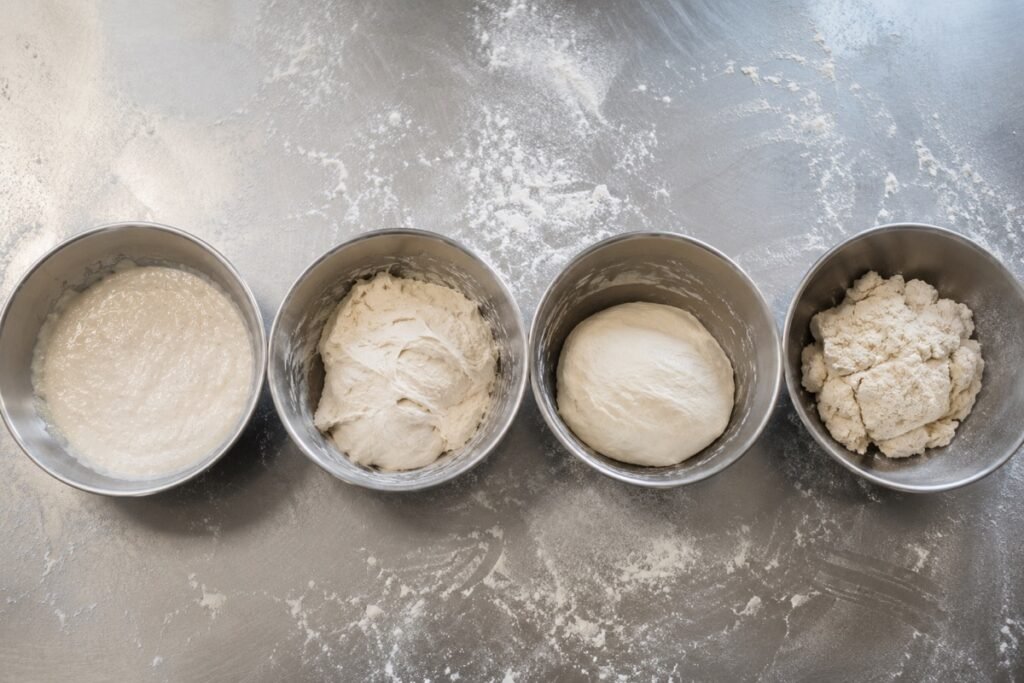
Bowl capacity in quarts tells you almost nothing about how much dough a mixer can handle. The number that matters is your dough’s absorption ratio. Hobart defines it as water weight divided by flour weight, expressed as a percentage.
Absorption ratio = water weight ÷ flour weight × 100
Wet dough is easy on a mixer. Stiff dough loads the motor and transmission hard, and rated capacity drops steeply as the ratio falls. The table below comes straight from Hobart’s published capacity chart (F-7701), which lists maximum dough weight by model and dough type. It is the clearest illustration of why quart size alone misleads buyers.
| Dough type | Absorption ratio | N50 (5 qt) | HL120 (12 qt) | HL200 (20 qt) | HL300 (30 qt) | HL600 (60 qt) |
|---|---|---|---|---|---|---|
| Whole wheat | 70% | n/a | 11 lb | 20 lb | 40 lb | 70 lb |
| Bread or roll, light to medium | 60% | 4 lb | 13 lb | 25 lb | 45 lb | 80 lb |
| Thick pizza | 60% | n/a | 11 lb | 20 lb | 40 lb | 70 lb |
| Heavy bread | 55% | n/a | 8 lb | 15 lb | 30 lb | 60 lb |
| Medium pizza | 50% | n/a | 6 lb | 10 lb | 20 lb | 70 lb |
| Thin pizza | 40% | n/a | 5 lb | 9 lb | 14 lb | 40 lb |
Read across the HL200 row and the point lands hard. That 20-quart mixer takes 25 lb of standard bread dough, but only 9 lb of thin pizza dough. Same machine, same bowl, less than half the capacity. Buy a 20-quart for a pizza shop on the strength of the bread number and you have bought a mixer that will run overloaded every shift.
Two caveats from Hobart’s own notes. High-gluten flour requires cutting batch size by a further 10%, as does using ice in the batch. Thin pizza dough at 40% AR also carries a five-minute maximum mixing time. For stiff dough in real volume, a spiral mixer beats a larger planetary, and our planetary vs. spiral comparison covers when to make that switch.
Step 3: Match to a Size Class
Countertop: 5 to 12 quarts
Roughly 4 to 13 lb of bread dough per batch, dropping to 5 or 6 lb for stiff pizza dough. This is the class for cafes, small restaurants, and prep stations that mix in bursts rather than continuously.
Build quality matters more than capacity here. An all-gear machine like the Hobart N50 will outlast several belt-driven lookalikes. If you need commercial certification and more capacity without giving up floor space, the NSF-certified KitchenAid KSM8990 is the standard pick.
Bench: 12 to 30 quarts
Roughly 13 to 45 lb of bread dough, or 9 to 20 lb of pizza dough. Small bakeries and pizza shops live here. A 30-quart machine running at 60% capacity is a better buy than a 20-quart running flat out every day. The 10-quart machines we have reviewed, the Vollrath 10-Quart and the budget-priced Uniworld 10 QT, sit just under this class and make sense for a shop growing into it. If you already mix dough daily, start at 20 quarts.
Floor: 30 quarts and up
A 60-quart machine handles 80 lb of bread dough or 40 lb of thin pizza dough per batch. High-volume bakeries, commissaries, and pizzerias producing hundreds of dough balls daily. Note that the bench-to-floor line is not purely a quart count: 30-quart machines ship in both bench-mounted and floor-standing configurations, so check the footprint as well as the capacity. This class splits into two very different tiers, and the price gap between them is not a discount. It reflects real differences in transmission, duty cycle, and service life.
Budget tier: imported light-duty machines
The VEVOR 30-Quart Commercial Mixer is the volume seller in this tier, with a 1100W motor, three speeds, 110V single-phase power, and a 150 lb footprint. The Happybuy 30Qt and the ROVSUN 30QT are near-identical machines from the same import category.
These are belt-driven and built for intermittent use. They earn their place in a startup pizzeria, a ghost kitchen, or a caterer’s prep space mixing a few batches a day. They are not built to run continuously for a decade, and parts availability is thin. Treat them as a three to five year machine, not a twenty year one.
Commercial tier: built for daily service
The Eurodib M30AETL 30-Quart is the sweet spot for most buyers stepping up. It is ETL certified and runs 110V single phase, which matters because many machines this size do not. The Omcan 30 QT 2 HP gear-driven and the Winco 30-liter with attachment hub are the direct competitors.
At the top of what Amazon carries, the Globe SP30 30-Quart Floor Planetary is NSF certified and sits at the top of this class. That is Hobart territory in both build and price, and it is the machine to buy if this mixer is the center of your production line rather than a support piece.
Plan the electrical supply before you order
Electrical supply is the constraint that decides which floor machines you can even consider. Most US kitchens have single-phase service, while many floor mixers assume three phase. Find out what your panel actually provides before you shortlist anything, because retrofitting three-phase service is an electrician job with a lead time, not a same-week fix.
If you are on single phase, filter for it early rather than falling in love with a machine you cannot power. Single-phase floor models exist, though the choice narrows quickly above 40 quarts. Watch imported listings especially carefully, since some ship with European wiring that will not run here at all. Our guide to the best commercial mixer for pizza dough walks through a specific example of that trap.
Two more things change at this scale. Attachment hubs start to pay off, letting one machine drive grinders, slicers, and shredders, though Hobart warns against using the hub while mixing. And you should budget for installation rather than just the machine. Floor mixers need a dedicated circuit, clear service access, and a floor that can carry several hundred pounds of machine plus a loaded bowl. Bowl dollies and spare bowls are near-essential at this size and rarely included in the listed price.
Worked Example: Sizing for a 200-Pizza Day
Abstract advice is easy to nod along to and hard to act on, so here is the arithmetic for a real case. A pizzeria sells 200 pizzas on a busy Saturday, mostly 14-inch, and wants one mixer to carry the whole day.
- Dough per pizza. A 14-inch pie takes roughly 14 oz of dough, which matches the common shortcut of one ounce per inch of diameter. Weigh your own dough balls rather than trusting an average, because portioning varies more between shops than most owners expect.
- Daily dough weight. 200 pizzas at 14 oz is 2,800 oz, or 175 lb of dough.
- Find the absorption ratio. New York style dough typically runs 60 to 65% hydration, which lands in Hobart’s thick pizza category at 60% AR.
- Read the capacity at that ratio, not the bowl size. At 60% AR, a 20-quart takes 20 lb per batch, a 30-quart takes 40 lb, and a 60-quart takes 70 lb.
- Divide. That 175 lb day means 9 batches on a 20-quart, 5 batches on a 30-quart, or 3 batches on a 60-quart.
A 30-quart machine is the practical floor here, and a 60-quart buys real breathing room. Nine batches on a 20-quart is not a mixer problem so much as a labor problem, because every batch costs scaling, mixing, resting, and cleanup time while heating a motor that never fully cools.
Now change one variable. Suppose the same shop makes thin or cracker-style crust at 40% hydration instead. Capacity collapses to 9 lb on a 20-quart, 14 lb on a 30-quart, and 40 lb on a 60-quart, which turns that identical 175 lb day into 20 batches, 13 batches, or 5 batches respectively.
Same pizza count, same shop, and the honest answer moves from a 30-quart to a 60-quart purely because the dough got stiffer. That is the whole argument for sizing on absorption ratio rather than bowl volume, and it is the most common reason a pizzeria’s first commercial mixer dies early.
Attachments and the Power Hub
A planetary mixer’s hub turns it into more than a mixer. Through a single geared port it can drive meat grinders, vegetable slicers, graters, and shredders, which is why a mixer often replaces two or three separate machines in a tight kitchen.
Hub sizes are standardized, and the size follows the machine class. Hobart introduced the #12 hub on the A120 and it became the industry default, appearing on 20, 30, and 40-quart mixers at a 1 and 3/8 inch diameter. The larger #22 hub is standard on 60, 80, and 140-quart machines, with some 80-quart models offering both.
This matters when buying accessories, because attachments are sold by hub number and the two are not interchangeable. A #12 grater and shredder attachment will not mount on a 60-quart machine. Confirm your hub number before ordering anything, and note that hub attachments from third parties like Alfa are usually a fraction of the manufacturer’s price for the same fitment.
Smaller countertop machines use the #10 hub. The Hobart N50 carries a #10 taper hub, and because KitchenAid uses the same standard, KitchenAid #10 attachments will mount on it. One caveat worth knowing: the attachment still has to suit a 5-quart bowl, so KitchenAid parts built for 6 or 7-quart machines are too wide to fit.
Certification and Safety Features Worth Paying For
Two acronyms decide whether a mixer passes inspection. NSF certification means the machine meets sanitation standards for commercial food contact, and many health departments require it for equipment in a licensed kitchen. ETL or UL listing covers electrical safety. A machine can carry one without the other, so check for both.
If the machine is going into a licensed kitchen, confirm NSF before you get as far as comparing capacities, because it can eliminate options you were otherwise ready to buy. Discovering it after installation usually means buying the mixer twice.
On the hardware side, a bowl guard is the interlocked cage that stops the agitator when opened. It is standard on bench and floor machines and worth insisting on, both for injury prevention and because inspectors look for it. Also confirm the machine has a bowl lift rather than a tilting head at 20 quarts and up. A full 30-quart bowl of dough weighs enough that lifting it by hand is a genuine injury risk.
When a Planetary Mixer Is the Wrong Tool
Sizing up is not always the answer. If dough is all you really make, a spiral mixer handles stiff, low-hydration dough with far less strain, because the bowl rotates while a fixed spiral hook works the dough rather than a planetary arm fighting it. High-volume pizzerias and bread bakeries usually end up here, and our planetary vs. spiral guide covers the tradeoffs.
At the other extreme, a vertical cutter mixer is built for speed rather than dough. It chops, emulsifies, and blends in seconds, which suits high-volume sauce, slaw, and cheese prep. It is not a dough machine, and buying one expecting it to knead is a costly mismatch.
The general rule: planetary for versatility across batters, doughs, and mixes, spiral for dough volume, VCM for speed on wet prep.
Sizing Mistakes That Kill Mixers
- Sizing to the bowl instead of the dough. A 20-quart mixer is a 25 lb bread machine and a 9 lb thin-pizza machine. Look up your actual dough type.
- Buying for today’s volume. Growing 20% a year means today’s right size is wrong in 24 months.
- Running stiff dough in an undersized planetary. This is the classic burned-out-motor story, and it usually voids the warranty. Our maintenance guide covers the warning signs.
- Ignoring the flour and ice adjustments. High-gluten flour and ice each cut usable batch size by about 10%, and they stack.
- Ignoring batch frequency. Ten small batches back to back heat a motor more than two large ones with rest between.
- Forgetting the electrical spec. Verify voltage and phase against your kitchen panel before ordering any bench or floor model.
Frequently Asked Questions
What size commercial mixer do I need for a pizza shop?
Most independent pizza shops need a 30-quart machine or larger, or a spiral mixer if dough is the main thing you make. Pizza dough runs a low absorption ratio of 40 to 60%, and Hobart rates a 20-quart planetary at just 9 lb of thin pizza dough against 25 lb of standard bread dough. A 20-quart that looks adequate on the bread number is undersized for pizza. Volume decides the rest: a 200-pizza day needs a 60-quart machine, as the worked example below shows.
How many pounds of dough fit in a 20-quart mixer?
Hobart rates its 20-quart HL200 at 25 lb of light to medium bread dough at 60% absorption, 15 lb of heavy bread at 55%, 10 lb of medium pizza dough at 50%, and 9 lb of thin pizza dough at 40%. Subtract about 10% if you use high-gluten flour or ice.
Is it better to buy a bigger mixer than I need?
One class up, yes. A mixer loafing at 60% capacity lasts dramatically longer than one maxed out daily, and it absorbs business growth. More than one class up wastes money and floor space, and oversized bowls mix small batches poorly because the agitator cannot reach a small quantity properly.
Do I need three-phase power for a commercial mixer?
Countertop and most bench mixers run on standard single-phase power. Larger floor models are commonly three-phase, and the likelihood rises with capacity. Check your kitchen’s electrical panel, or ask your electrician, before ordering. Rewiring costs can exceed the price difference between models.
What is a good absorption ratio for dough?
It depends on the product, not on what is easiest for the mixer. Whole wheat runs about 70%, standard bread and roll dough about 60%, heavy bread about 55%, and pizza dough anywhere from 40% for thin crust to 60% for thick. Because lower ratios make stiffer dough, the ratio that matters when sizing is your most demanding product, not your typical one.
Bottom Line
Weigh your biggest real batch. Look up its absorption ratio, then find the mixer size rated for that weight at that ratio rather than trusting the bowl number. Add three years of growth, and round up rather than down. Then pick the best-built machine in that class, starting with our mixer reviews.
Capacity figures cited from Hobart Mixer Capacity Chart F-7701, all models, based on 12% flour moisture at 70°F water temperature. Individual manufacturers publish their own charts, so confirm against the spec sheet for the model you are buying.
Sizing is one of four decisions in buying a mixer. Our commercial mixer buying guide covers the other three: choosing a type, picking a build tier, and confirming certification and power.
Mixing mostly pizza? Our guide to the best commercial mixer for pizza dough applies this sizing method to low-hydration dough specifically.
Running a bakery specifically? Our guide to the best commercial mixer for a small bakery converts this method into loaves per day.
Sizing affects lifespan directly, since a mixer run at its limit wears fast. Our guide to how long a commercial mixer should last covers the consequences.
We may earn an affiliate commission when you purchase through links on our site. This keeps it 100% reader-supported and free of ads or sponsorships. Thanks for your support!