
We may earn an affiliate commission when you purchase through links on our site. This keeps it 100% reader-supported and free of ads or sponsorships. Thanks for your support!
Maintaining a commercial mixer is what stands between years of reliable service and a sudden, expensive breakdown in the middle of a shift. A machine that is cleaned, lubricated, and inspected on a schedule runs more efficiently, passes health inspections, and holds its resale value. One that is neglected fails early, and a replacement floor mixer can cost several thousand dollars. Most of the work takes minutes and needs no technician.
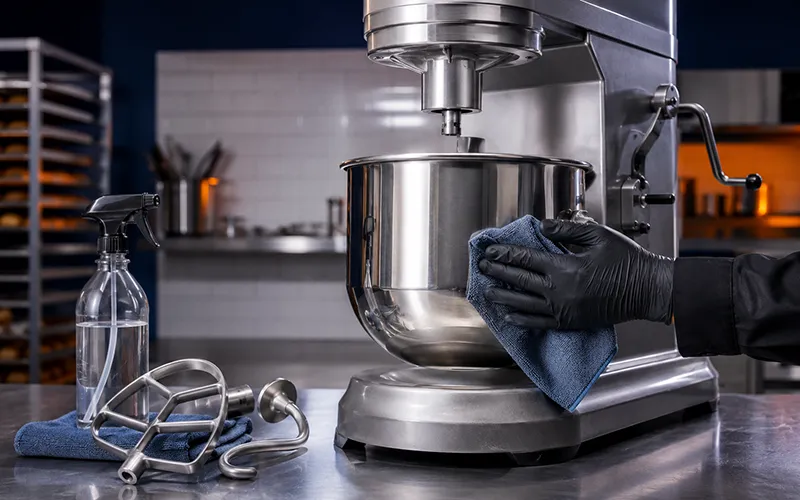
Beyond longevity, upkeep is a food-safety requirement. A dirty mixer is a route to cross-contamination, foodborne illness, and health-department citations. Worn or dry moving parts cause mechanical failures that can injure an operator. Keeping the machine clean and serviced protects your food, your staff, and your bottom line at once.
Commercial mixer maintenance schedule at a glance
Use this cadence as a starting point, then defer to your owner’s manual where it specifies different intervals for your model.
| Frequency | Task |
|---|---|
| After every use | Wipe the exterior, wash the bowl and attachments in hot soapy water, sanitize food-contact surfaces |
| Weekly | Deep clean the gears, crevices, and bowl-lift area; inspect the power cord and plug for damage |
| Monthly | Lubricate the bowl-lift slide rails with NSF H-1 food-grade lubricant; check for loose fasteners and belt wear |
| Twice a year | Lubricate the bowl-height adjustor and slides; tighten hardware; test the safety guard and interlock switch |
| Annually | Schedule a professional service to inspect internal gears, bearings, and the transmission oil |
How to clean and sanitize a commercial mixer
Clean the machine after every use, before residue has a chance to dry into the gears and crevices. Work through these steps in order:
- Unplug the mixer. Never clean a machine that is still connected to power. This is the single most skipped step and the most dangerous one.
- Remove the bowl and attachments. Wash them in hot, soapy water, then scrub with a brush and a food-grade sanitizing solution.
- Wipe the exterior. Use a damp cloth and mild detergent on the head, column, and base. Avoid soaking any electrical housing.
- Clean the food-contact interior. Use the same sanitizing solution to lift food particles and stains from the bowl seat and beater shaft.
- Target the hard-to-reach areas. The gears and the crevices around the attachment hub trap the most residue and cause the most problems.
- Rinse and dry completely. Reassemble only once every part is dry, so no moisture reaches the motor or bearings.
Always cross-check your manufacturer’s instructions, which may call out cleaners or techniques specific to your finish and seals.
Cleaning hard-to-reach places
For the tight spots that a cloth cannot reach, disassemble the machine as far as the manual allows, then use the right tool for the gap:
- Gears and hub crevices: a toothbrush or small detail brush to work residue loose.
- Narrow channels and threads: a pipe cleaner or wooden skewer, worked gently so you do not gouge a seal or bend a part.
- Dried dough: soften it with warm water first rather than forcing it out, which is where most crevice damage happens.
Rinse and dry every part before reassembly.
How to lubricate a commercial mixer the right way
Proper lubrication keeps the gears, slides, and bearings moving smoothly and is the difference between a mixer that runs quietly for a decade and one that grinds itself into a repair bill. The rules that matter most:
- Use only NSF H-1 food-grade lubricant. This rating certifies the lubricant is safe for incidental food contact in a commercial kitchen.
- Never use WD-40 or automotive grease. They are not food-safe, they violate health codes, and they can contaminate product.
- Lubricate the bowl-lift slide rails monthly. These get coated with dry and moist ingredients and are the parts you will notice first when they are dry.
- Service the bowl-height adjustor twice a year, and grease the gear housing when it begins to squeak or per your manual’s schedule.
- Unplug the machine first, and wipe away old grease before applying new so grit does not accumulate.
Regular maintenance tasks that prolong mixer life
Cleaning and lubrication cover most of the job. A short weekly inspection catches the rest before it turns into downtime:
- Check for loose or damaged parts: tighten loose screws, and replace worn gears or bearings before they seize.
- Inspect the electrical connections: look over the wires, plug, and cord for fraying or scorching, and confirm everything is seated.
- Replace worn belts: a glazed or cracked belt slips under load and drops mixing power.
- Listen and feel: new grinding, knocking, or vibration is an early warning. Track it down before it spreads to other parts.
How to troubleshoot common mixer problems
Most faults trace back to a handful of causes. Start with the symptom and work through the likely culprits before you call for service:
| Symptom | Likely cause and first check |
|---|---|
| Grinding noise | Gears or bearings need lubrication or replacement |
| Will not turn on | Check the outlet, plug, and any tripped interlock or safety switch |
| Runs but mixes poorly | Verify the speed setting, then inspect the drive belt for slippage |
| Oil leaking | A worn seal or overfilled gearcase; stop use and have it inspected |
| Overheating | Overloading past rated capacity, or a failing motor or bearing |
If the manual’s troubleshooting page does not resolve it, or you are not comfortable going further, stop and call a professional rather than risk a bigger fault.
When to call a professional for repairs
Cleaning, lubrication, and inspection are owner tasks. Bring in a technician when the job crosses into electrical or internal-drive territory:
- Electrical faults: a machine that will not power on, or any burning smell or sparking, is an electrician’s job.
- Gear, bearing, or belt failure: internal drive work calls for a mixer technician with the right parts.
- Anything under warranty: most warranties are voided by self-repair, so let an authorized service handle it.
- Any doubt about safety: if you are unsure the machine is safe to operate, do not guess. Have it checked.
Safety guidelines for using and servicing a mixer
Safety comes first every time the machine is used or serviced. Build these habits into your kitchen’s routine:
- Follow the manufacturer’s instructions and honor every warning label and safety precaution.
- Train every operator before they run the mixer, so no one learns on the job with their hands near moving parts.
- Confirm the safety features work: the guard should be installed and the interlock should cut power when it is lifted.
- Verify grounding and secure connections, and keep the work area clear of clutter that could cause a slip near a running machine.
Safety features to look for in a commercial mixer
If you are shopping for a machine, these features protect both your staff and the mixer itself:
- Safety guard: a barrier over the moving parts and bowl that keeps hands out during operation.
- Interlock safety switch: automatically shuts the mixer off the moment the guard is removed.
- Emergency stop button: essential for commercial use, letting an operator halt the machine instantly.
- Thermal protection: guards the motor by cutting power before it overheats under a heavy load.
- Anti-slip feet: keep the mixer planted and stable through high-torque dough work.
Frequently asked questions
How often should I clean a commercial mixer?
Wipe the exterior and wash the bowl and attachments after every use, before residue dries into the gears. Do a deeper clean weekly, disassembling as far as the manual allows to reach the hub and gear crevices.
What lubricant is safe for a commercial mixer?
Use only an NSF H-1 rated food-grade lubricant, which is certified safe for incidental food contact. Never use WD-40 or automotive grease, as they are not food-safe and violate health codes.
How often should I lubricate a commercial mixer?
Lubricate the bowl-lift slide rails about once a month, and service the bowl-height adjustor and slides roughly twice a year. Grease the gear housing when it begins to squeak or on the schedule in your manual, and have the internal gears and transmission checked during annual professional service.
Which mixer repairs should I leave to a professional?
Handle cleaning, lubrication, and inspection yourself. Call a technician for electrical faults, internal gear or bearing failure, belt replacement, or any repair on a machine still under warranty, since self-repair usually voids the warranty.
Keep your mixer running for years
It comes down to a rhythm: clean after every use, lubricate the right parts with NSF H-1 grease on a monthly and twice-yearly rhythm, inspect for loose hardware and worn belts each week, and book a professional service once a year. Address small issues the day you notice them rather than waiting for them to grow. A mixer treated this way outlasts its warranty by years and keeps your kitchen moving through every rush.
Undersizing is one of the most common causes of premature mixer failure. Our commercial mixer sizing guide explains how to match a machine to your dough before it becomes a maintenance problem.
Buying the right machine in the first place prevents most maintenance headaches. Our commercial mixer buying guide walks through choosing one.
Wondering whether yours is nearing the end? Our guide to how long a commercial mixer should last covers realistic service life and when repair stops paying.
We may earn an affiliate commission when you purchase through links on our site. This keeps it 100% reader-supported and free of ads or sponsorships. Thanks for your support!